

Inviting Movements in Physiotherapy
A new open access book from the Critical Physiotherapy Network

If you've ever been involved in a big collaborative writing project, you'll know how much of a joy it is when you see the product of your collective labourers in print.
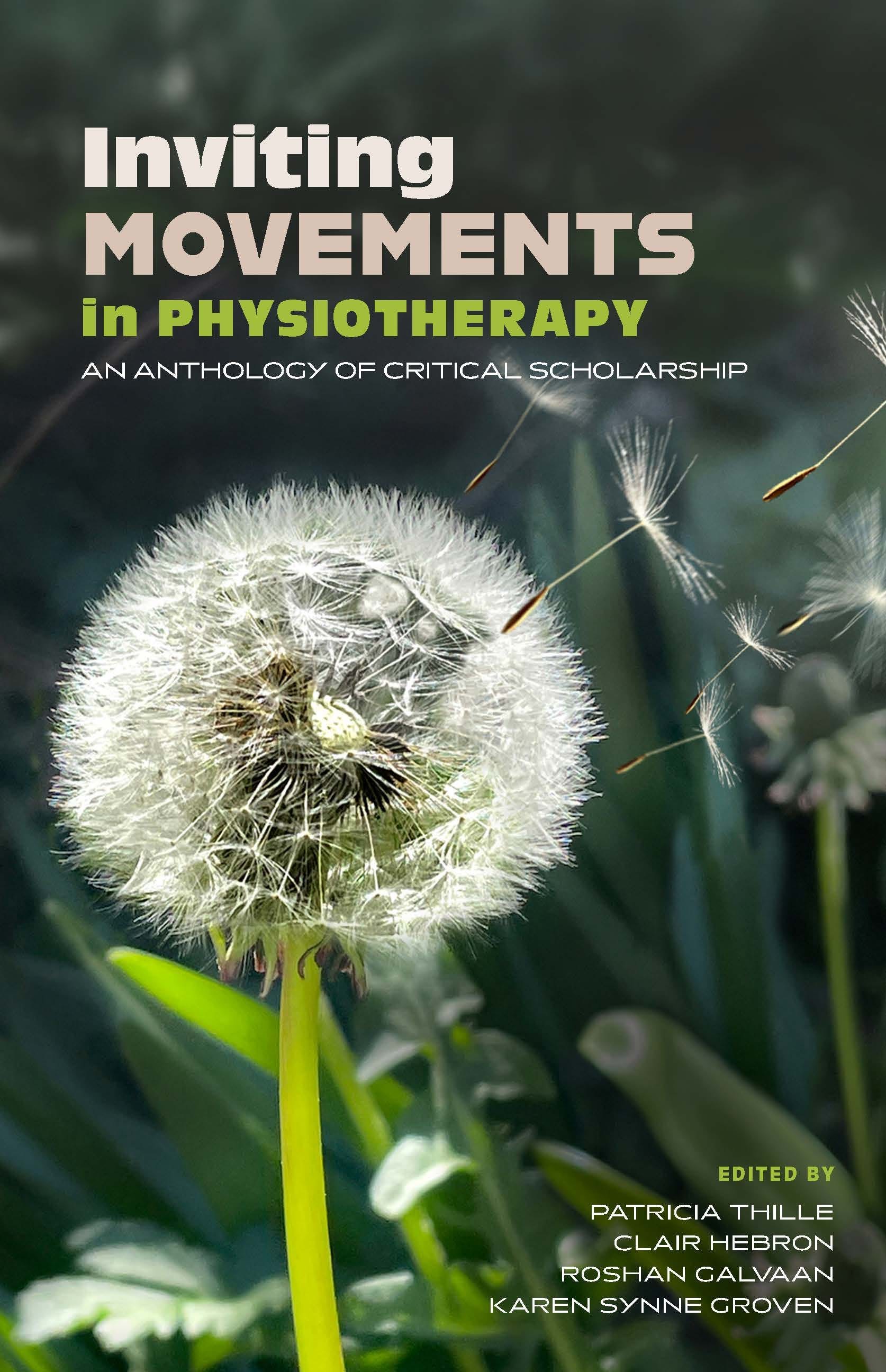
Well, late last week the editors of the latest anthology of critical physiotherapy writings announced the publication of Inviting movements in physiotherapy: An anthology of critical scholarship.
This is the third in the series of edited collections produced by the CPN and, having been involved in editing the first two and writing chapters for all three, I have a deep appreciation for the work that the four editors — Patty Thille, Clair Hebron, Roshan Galvaan and Karen Synne Groven — have done in pulling this fantastic anthology together.
You can read or download the completely free, open-access book here.
One of the biggest challenges in producing the book was finding a publisher who could make the book available as an open source text, free to anyone who wanted to download it. I know how hard the editors worked to make this a reality – to give anyone and everyone an opportunity to be exposed to some of the most interesting, cutting edge writing in physiotherapy today. Huge congratulations to the editors for pulling this off. And huge thanks to the University of Manitoba for their support.
But also for producing such a beautiful piece of work.
The CPN has been through a careful, judicious process of community engagement over the last couple of years, and the Network Executive has gone to real pains to ground the CPN in the realities of modern healthcare, whilst maintaining the same safe space for radical and alternative thought that has always been the hallmark of the Critical Physiotherapy Network.
This book then marks something of a turning point in the evolution of the CPN, and I would encourage you all – physiotherapists or otherwise – to become (free) members of the network.
There are very few communities like this in healthcare; communities that are designed to empower serious critical thought on the future of professions like physiotherapy, which have, for the longest time, baulked at the idea of critical self-scrutiny.
You only have to look at the chapters included in this anthology to realise that physiotherapy is maturing as a profession.
Those within and without the profession are more comfortable asking questions about knowledge, power and truth then they were in the past, and the depth of theoretical, sociological, and philosophical scholarship here a second to none.
So I'd encourage you all to download a free copy of the book and to dig into some of the most interesting and creative minds in the profession.
It is a thing of beauty.
Inviting movements in physiotherapy: An introduction (Eds. P. Thille, C. Hebron, R. Galvaan, & K. S. Groven)
Table of contents and authors
Part 1: Being moved by experience and voice
1. “I didn’t come to work in a coffee shop”: The untold stories of transnational physiotherapists in Canada (J. J. Andrion)
2. Ukuyankaza kuyi-Nkululeko, Movement is freedom: Journeying towards autoethnography as a transformative qualitative research methodology (M. N. Ntinga, H. Kathard, F. Maric, K. Abrahams, & S. L. Amosun)
3. Unbelonging: The experience of being-in-society whilst living with frozen shoulder (C. Hebron)
Part 2: Relinquishing stability and risking movement
4. Destabilising the norm: A critical experimental approach to move physiotherapy beyond movement 'normalisation” (S. M. Schwab-Farrell, R. Mayr, T. J. Davis, M. A. Riley, & P. L. Silva)
5. "The impact of the occupation remains with us": Movements of minor education during political mobilization of physiotherapy students at a federal university in southern Brazil (D. M. Lagranha, A. Vieira, & A. B. Fraga)
6. Disrupting the ongoing flow of weight stigma in physiotherapy: The value of critical reflection (P. Thille, Z. A. Leyland, & L. Harvey)
7. Belonging and identity in physiotherapy (C. Bulley, K. C. Jagadamma, J. Culpan, & J. V. Lane)
8. Power dynamics of knowledge in physiotherapy education: The case of Mensendieck (T. Dahl-Michelsen, D. Nicholls, J. Messel, & K. S. Groven)
Part 3: Rupturing movements and radical imaginations
9. Art as a deterritorialising vehicle for a nomadic physiotherapy (S. Chubb & C. Hebron)
10. Walking, mobility, and movement in physiotherapy (T. Sudmann)
11. The possibilities for a posthuman physiotherapy (D. A. Nicholls, M. Low, & F. Maric)
12. “The constant fear of ceasing to move”: Deconstructing movement in physiotherapy (A. I. Rajala & T. Uotinen)